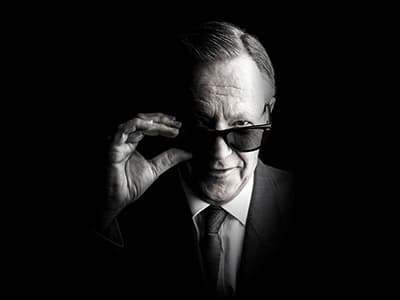
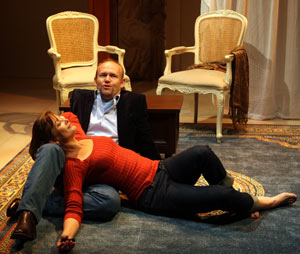
 Left - Kate Raison and Brian Meegan. Cover - Brian Meegan. Photos - Steve Lunam
For those who appreciate simple, essentially naturalistic theatre or are simply a little worn out by the more esoteric or spectacular fare of the recent Sydney Festival, Ninety is a pleasing change of pace. A strong two-hander presenting an intimate yet confronting exchange between two people trying to come to terms with their shared history after a traumatic split, Joanna Murray-Smith’s play is pithy, unpredictable, and ultimately quite moving.
One of the piece’s strengths is that in a relatively short span of time it presents us with two believable, ordinary characters who are not only richly drawn but also manage to range from thoroughly endearing to genuinely off-putting, all within the space of a single conversation. Indeed, the fact that Murray-Smith is willing to court an audience’s ambivalence by making her characters both stray well into unsympathetic waters bespeaks her confidence in portraying human foibles in characters in whom you ultimately still feel invested.
William and Isabel are two strong personalities from somewhat different backgrounds who meet at university as teacher and student and, after finding each other fairly annoying at first, fall in love and wed. Their marriage eventually collapsed and they became relatively estranged, William has since become a famous actor on American TV, while Isabel led a more solitary life as an art restorer. Now, on the eve of William’s marriage to a glamorous younger actress, Isabel has summoned him to talk about what went wrong between them and, after a fashion, try to win him back. William has afforded her ninety minutes to make her pitch.
This is, unquestionably, a character piece in which the post-mortem of a relationship is the one consuming topic, and pretty much any other detail is deemed extraneous. Apart from some fleeting technological references the play seems to be taking some pains to avoid being tied down in terms of geography or time, other than being apparently Australia and in the relative present-day (details thus easily changed, possibly to facilitate adaptation to overseas markets). Moreso – unless a close reading would demonstrate otherwise – the script appears to be fairly open-ended about the characters’ ages other than that they are not young, certainly, and William would seem to be older than Isabel. Although this production has cast actors approaching early middle-age, it seems written in such a way that older or even slightly younger actors could fill the roles, and by the same token it does not indicate clearly how long these two were together.
This open-endedness is indicative of a generally pleasing subtlety to Murray-Smith’s script, in that these characters’ fuller dimensions and a clearer picture of their past is only gradually revealed, with their intertwined love and resentment seeming all the more engrossing by this process of slow disclosure. Indeed, although the play does eventually reveal that there were (and still are) some much deeper issues at work than a marriage breakdown, the way these initially withheld pieces of vital backstory emerge never smacks of a contrived twist or a big reveal. Indeed, by avoiding opening exposition almost altogether, the “story” that emerges (being one extended conversation it really doesn’t have a traditional plot) is that of their entire relationship and how it got to this less-than-cordial state.
Effectively, Murray-Smith has created the illusion of extreme naturalism - by not having her characters waltz in and spout backstory that each other would already know perfectly well for the benefit of the audience, it gives the appearance of a believable conversation that would seem relatively obscure to us, positioned as the proverbial fly on the wall. Of course, what is actually going on is a carefully structured trickle of information that causes you to continually revise and reconsider your prior assumptions about the characters, their attitudes, and behaviour. It’s deftly done, and if any general criticism is warranted it would be that from about halfway in Murray-Smith starts using brief flashbacks - signaled by a shift in lighting palette - to further flesh out and contextualise the characters’ debates and increasingly poignant memories.
I don’t object to the technique in and of itself other than its obviousness (and the fact that it marginally disrupts the play’s premise of dramatising the titular ninety-minute conversation in realtime), but their accelerated frequency as the play draws to a close becomes a little clumsy. Were it not for the fact that most of these micro-scenes are actually very good, their inclusion would seem like a bit of structural awkwardness. In fact, the actors themselves exhibit some difficulty in keeping their performances across these time periods distinct once the emotions become increasingly heightened towards the climax and start to bleed through. Unless of course this is actually Murray-Smith’s point -- that in emotional conversations that dredge up the ancient history, one’s feelings from past and present can blurr together. If so, the notion is a bit lost in her overuse of this well-worn dramatic technique.
Even with an overall strong script such as this to work with, the production remains chiefly dependent on the skill of the two actors who evenly share the dramatic load. Fortunately director Sandra Bates has, as usual, chosen well. We are treated to an excellent performance from Kate Raison as the cocky, complex Isabel. As the “aggressor” in the play, Isabel has clearly set up this confrontation with a goal in mind but a way of going about it that is about as far from cajoling as you can imagine. However Raison is, if anything, outshone by a whisker thanks to Brian Meegan’s superb command of his character’s vacillation between defensive arrogance, vulnerability and sly humour. His portrayal of William manages to nail perfectly Murray-Smith’s slightly heightened naturalism, and steals the show a couple of times with both priceless comic timing and aching pathos.
Although some may consider this genre of theatre to be old hat or declare its affluent characters “not relevant”, it comes well recommended to those seeking some deceptively simple, well-crafted theatre that is light on melodrama but powerful in its unvarnished humanity.
Ensemble Theatre presents
Ninety
by Joanna Murray-Smith
Director Sandra Bates
Venue: Ensemble Theatre | 78 McDougall Street, Kirribilli NSW
Dates: 4 February – 3 April
Duration: 90 minutes, no interval
Bookings: (02) 9929 0644 | www.ensemble.com.au